A factory, an oil depot, a power substation or a logistics hub have one thing in common: their outer boundary is often long, poorly lit and rarely watched around the clock. Perimeter security is about spotting an intrusion there, before it reaches the buildings. This guide covers the available technologies, how to combine them and what to prepare before a project in Tunisia.
What is perimeter security?
Perimeter security aims to detect, locate, qualify and track an intrusion attempt before or at the moment a site's physical boundary is crossed. Unlike plain video surveillance, it never relies on a single technology: it combines several sensor families based on different physical principles. Waycon has designed and integrated these architectures in Tunisia since 2004, with teams in Ariana and Sousse. For details on each technology, see our perimeter intrusion detection page.
A layered architecture
One technology may excel at detecting a presence, another at locating or identifying it. A solid project therefore stacks several layers:
- Before the fence: radar, microwave or infrared spot the approach.
- On the fence: optical fibre, sensing cable or vibration sensors detect climbing or cutting.
- Underground: buried cables and seismic sensors detect without being seen.
- Verification: thermal cameras, PTZ and AI analytics confirm the alarm and follow the intruder.
For example, a radar detects a person approaching before they even touch the fence, then passes the coordinates to a thermal or PTZ camera that tracks them automatically.
Fence detection: fibre, cable, vibration
Optical fibre (DAS)
An interrogator unit injects light pulses into a fibre mounted on the fence or buried. Vibrations from climbing, cutting or footsteps alter the backscattered light, so the event can be located along the cable. It is the answer for perimeters several kilometres long: borders, pipelines, industrial sites. No field electronics and immune to electromagnetic interference; it does require a site survey and careful calibration.
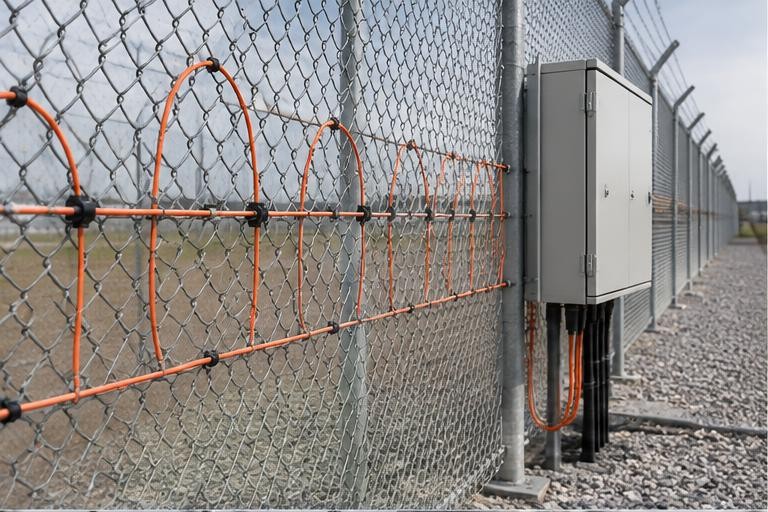
Sensing electric cable
Fixed to the mesh, it turns mechanical stress (climbing, cutting, impact) into an electrical signal analysed by zone. A proven option for medium-length fences.
Mechanical vibration sensors
Spread along the fence, they pick up the shaking typical of a crossing attempt. They suit rigid fences and sites that want location by section.
Zone detection: radar, microwave, infrared
Perimeter radar
Radar watches a wide open area in front of the fence, day and night, and gives the position of every target. Paired with a PTZ camera, it enables automatic tracking of an intruder. It suits large estates: solar farms, airports, port areas.
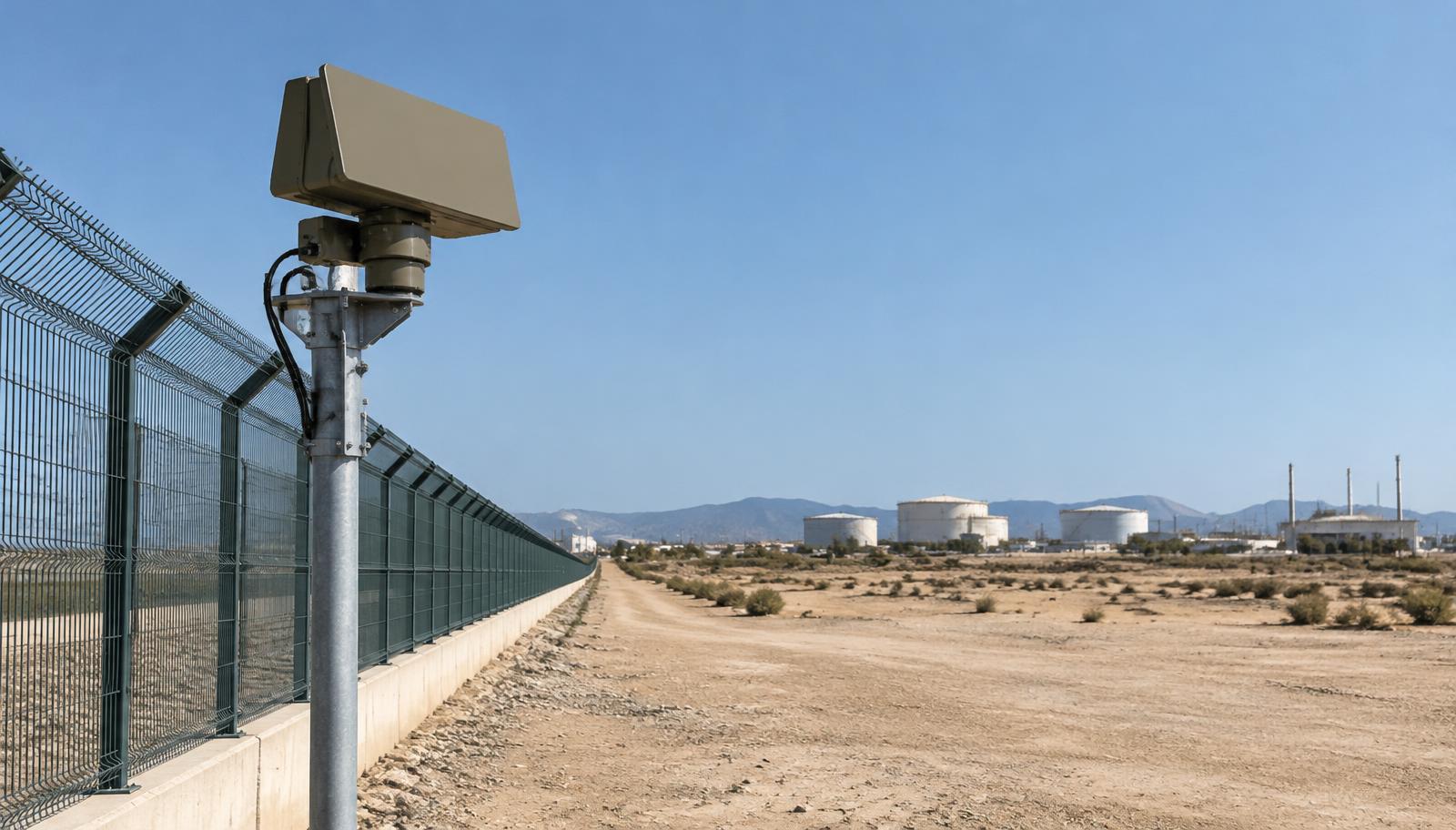
Microwave (radio-frequency) barrier
A transmitter and receiver create an invisible detection volume between two points. It suits open ground and corridors between two fences.
Active infrared barrier and outdoor PIR
Multiple infrared beams detect a precise crossing at gates, entrances and choke points; multi-beam models reduce detections caused by small animals. Outdoor PIR, passive and cost-effective, completes protection around buildings.
Invisible detection: buried cables and seismic
Buried TX/RX cables create a detection field in the ground along the perimeter. Seismic sensors pick up ground vibrations from footsteps or a vehicle. Being invisible, these solutions can't be spotted or bypassed, and they keep sites looking clean where an instrumented fence isn't wanted.
Video verification: thermal, PTZ and AI
Thermal cameras
They detect heat from a person or vehicle, with no lighting and at long range, even in total darkness, light smoke or vegetation. They are the perimeter's eyes at night.
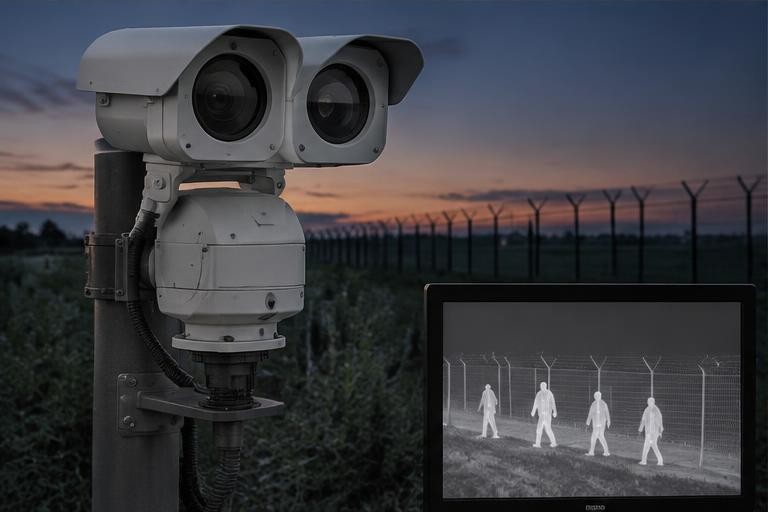
Optical and thermal PTZ
Able to pan, tilt and zoom, PTZ cameras point automatically at the zone in alarm and follow the target for the operator.
AI video analytics and Edge detection
AI tells a person or vehicle apart from an animal, a shadow or foliage, which sharply cuts false alarms. Processing can run inside the camera (Edge). Hikvision, a Waycon partner, applies this with AcuSense; read our AcuSense article. See also our AI video surveillance page.
Autonomous drones for alarm verification
On very large sites, an automated drone station can fly to the zone in alarm and stream a live aerial view. See our article on the drone as first responder (DFR).
Supervision and alarm verification
Perimeter alarms prove their worth when they reach a single supervision station: site map, zone in alarm, matching image and the procedure to follow. The operator checks, qualifies and dispatches a response. The perimeter also links to access control and vehicle access (ANPR), so authorised entries don't raise alarms. See our supervision and hypervision page.
Which sites need it?
- Industry and logistics: factories, warehouses, storage yards and vehicle fleets.
- Energy: oil and gas sites, pipelines, substations, solar and wind farms.
- Institutions and sensitive sites: government buildings, embassies, sovereignty sites.
- Transport: ports, airports and depots.
See also our perimeter security solution and our energy sector page.
Selection criteria
The right mix of technologies depends on eight criteria, reviewed during the site visit:
- perimeter length;
- fence type (mesh, wall, rigid);
- topography and vegetation;
- roads, traffic and animals;
- weather conditions (wind, dust, rain);
- threat level and site criticality;
- how precise the location needs to be;
- power and network available along the perimeter.
Mistakes to avoid
- relying on one technology for the whole perimeter;
- installing detectors without video to verify alarms;
- ignoring vegetation, wind and animals, which cause false alarms;
- forgetting power and network along the fence;
- not defining who handles the alarm and how;
- skipping calibration and commissioning tests.
Checklist before requesting a quote
- the site plan and the length of perimeter to protect;
- the fence type and its condition;
- the most sensitive areas and existing entrances;
- the surroundings: vegetation, nearby roads, wildlife, weather;
- equipment already installed (cameras, detectors, network);
- how monitoring is organised (guard post, remote monitoring, on-call).
Gather these points, then contact us: a site visit lets us size the solution. For the full picture of a project, see our guide to electronic security integration.